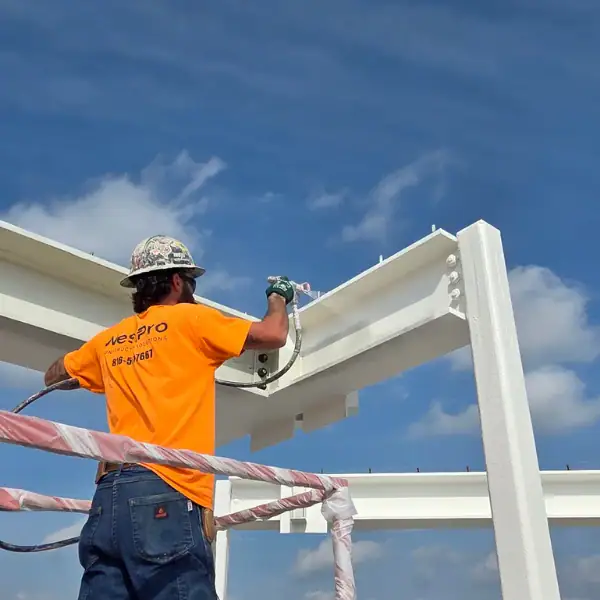

Nettles has become an industry leader in engineered flowable fill (check out our recent blog post about the advantages of EFF). For EFF projects, our experienced team uses Low-Density Cellular Concrete (LDCC) as a lightweight, highly flowable engineered fill solution.
What is LDCC?
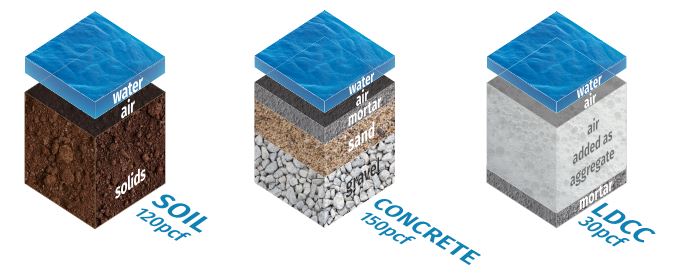
Low-Density Cellular Concrete (LDCC) is a mixture of Portland Cement, water, and Preformed Foam. The foam creates a structure of discrete air cells within the concrete, increasing volume, reducing density, and improving flowability. Mix designs may use fly ash, sand, and other aggregates to achieve specific densities and strengths. These properties make LDCC ideal for a variety of geotechnical applications. There are several manufacturers of LDCC Engineered Fill including Elastizell and Aerix. Each manufacturer uses a little different formulation for their LDCC but their properties are similar.
LDCC is produced on-site using a mobile batch plant and pumped into place. A slurry of cement and water is injected with preformed foam and can be pumped substantial distances, making placement easier in confined and/or high-traffic areas. Daily production from mobile batch plants can exceed 2,000 CY/day and multiple batch plants can be utilized for high-volume jobs.
What Are the Advantages and Applications of LDCC?
LDCC offers many unique advantages over traditional engineered fill, including:
- High strength-to-weight ratio
- Customizable mix designs
- No compaction
- Flowability eliminates voids
- Not affected by petroleum-based products
- Low maintenance and easily excavated
- Air increases volume 3-8 times, reducing freight cost and truck traffic
- Low permeability reduces loads and issues with drainage and freeze/thaw cycles
The Nettles team uses LDCC for all our engineered flowable fill projects, including MSE and RSS wall backfill, landslip repair, tunnel and pipe backfill, utility insulation, and soil stabilization. LDCC is an excellent backfill material for retaining walls and foundations because it exerts no lateral pressure on adjacent structures and its low permeability reduces the lateral pressure associated with water intrusion. The lightweight and highly flowable nature of LDCC also makes it ideal for elevated plaza and garden structures, MSE walls, annular space grouting, and utility fills.

Frequently Asked Questions about LDCC
How does low-density cellular concrete differ from conventional flowable fill (CLSM)?
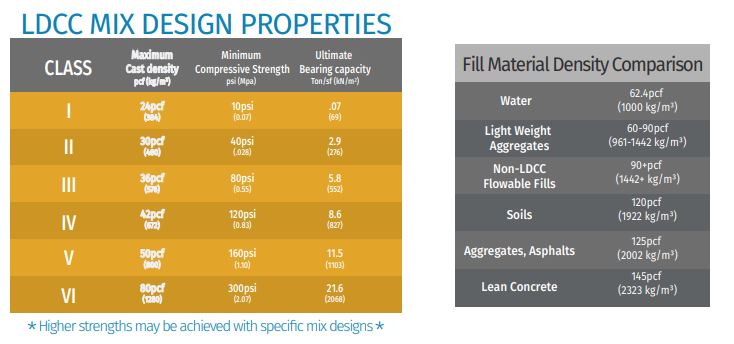
Low-density cellular concrete is a specific type of CLSM (controlled low-strength material), the broader category of flowable fill. It replaces most of the aggregate in a standard cement slurry with preformed foam, which typically brings density down to roughly 20 to 50 pcf (pounds per cubic foot), compared to roughly 115 to 145 pcf for conventional CLSM. That weight difference matters because standard flowable fill can overload weak soil, add lateral pressure on a retaining wall, or exceed what an aging structure can safely carry. Low-density cellular concrete fills the same void without adding that load.
How long does low-density cellular concrete need to cure before other trades or continued excavation can proceed?
Most mixes support light loads within several hours and reach full design strength around 28 days. Multi-lift applications like MSE (mechanically stabilized earth) wall backfill require each lift to cure before the next is placed.
Does low-density cellular concrete cost more than conventional select fill or compacted granular backfill?
Material cost per cubic yard is typically higher than granular fill, but total installed cost is often lower since it eliminates compaction equipment. Because LDCC can be mixed, delivered, and installed faster than standard select fill, you save time and money over the lifecycle of the project.
Can low-density cellular concrete be placed in wet conditions or where there's a high water table?
Yes, once cured. Standard backfill-grade LDCC mixes are designed to block water rather than absorb it, so they resist water intrusion once set. Active groundwater should still be dewatered before placement.
However, permeable low-density cellular concrete (PLDCC) is engineered to let water pass through rather than block it. This is used for specific drainage applications, so the standard and permeable mixes shouldn’t be substituted for each other without checking the design intent.
Does low-density cellular concrete placement require forms or containment?
In most vertical or sloped applications, yes. It needs a trench wall, sheeting, a form, or the void itself, as in annular space grouting, to hold its shape while curing. Flat backfill areas often use existing site conditions for containment instead.
How far can low-density cellular concrete be pumped from the mixing plant?
Up to about 800 feet under typical setups, and further with proper positioning of the foaming system. Because the mixing equipment doesn’t need to be located next to the placement area, low-density cellular concrete can be poured far from active work zones and through tight staging spaces on congested sites.
Have more questions about LDCC or engineered flowable fill?
Contact an expert to see how we can help.