

Tectum Roof Deck Systems
Expert Tectum roof deck installation across the Midwest and South Central US
What are Tectum Roof Deck Systems?
Tectum roof deck panels have been specified in roofing construction for decades. Especially common in the ‘60s and ‘70s, they are often used in applications like gymnasiums, natatoriums, classrooms, and restaurants, where acoustical insulation is a priority.
Panels are made of sustainable aspen wood fiber bonded with inorganic hydraulic cement, creating a durable and high-performing deck.
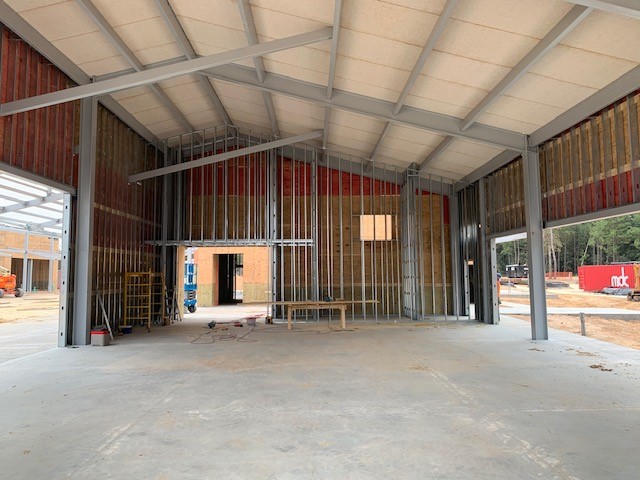
Tectum Roof Decks vs. Traditional Roofing Systems
Tectum roof deck panels do the job of the structural deck, the insulation substrate, and the finished acoustical ceiling in a single component. Fewer systems to specify, fewer trades to coordinate, and fewer places for a roof to fail.

Tectum Roof Decks
One panel replaces three systems: structural deck, insulation substrate, and finished acoustical ceiling — installed once, exposed underneath, no additional ceiling layer required.
- Acoustic performance built in. Depending on the Tectum type, roof deck panels achieve an NRC (Noise Reduction Coefficient) of up to 0.80, providing acoustic control in gyms, natatoriums, and auditoriums without adding a drop ceiling.
- R-values up to 44 as part of a complete structural roof deck assembly, without stacking a separate insulation board on top.
- UL-classified assemblies (Tectum E & E-N) and fire-retardant-treated wood options (Tectum V) that meet code requirements under IBC Section 603.1 without an added fireproofing step.
- Long-span capability up to 12 feet with Tectum V, meaning more compatibility for a wide range of buildings.
- Compatible with virtually any roofing membrane, so specifying Tectum doesn't lock the project into one roofing system.
- Contributes to EPD, HPD, and supports LEED v4, offering a sustainable, reliable, and long-lasting solution.

Traditional Roofing Systems
Traditional built-up assemblies are the default because they’re familiar, but the tradeoff shows up once the project is underway.
- Acoustic performance isn't part of the structural deck or insulation at all; it's a separate suspended ceiling or acoustic treatment added afterward.
- Insulation is a distinct layer laid on top of the structural deck, so the R-value depends entirely on the project specs, and there's no thermal contribution from the deck itself. More insulation to hit a target R-value means more material cost and more roof height.
- Traditional roofing systems typically aren’t fire-rated on their own; the fire rating comes from a separate fireproofing application, assembly listing, or the roofing system layered above. That's another product, another install step, and another manufacturer's spec to coordinate.
- Traditional systems are often less sustainable and provide fewer certification credits compared to Tectum roof deck panels.
Where Tectum Roof Deck Systems Are Used
Tectum roof deck is a great choice for projects where acoustics, structural performance, and finished appearance all matter, which is why it’s specified across these building types:
- Gymnasiums & athletic facilities: NRC up to 0.80 dampens the reverb from whistles, bouncing balls, and crowd noise, without a drop ceiling cutting into clearance height.
- Schools & classrooms: Exposed acoustical roof deck controls sound transfer between classrooms, cafeterias, and gyms.
- Natatoriums (indoor pools): For high-humidity environments, Tectum III or Tectum IIIP provides excellent durability and insulation while still managing the acoustics pool spaces are known for.
- Churches & worship spaces: Acoustic performance designed for spaces where speaking and vocal clarity matter
- Cafeterias & multipurpose rooms: Built-in noise control matters in shared-use spaces where hard, reflective surfaces would otherwise amplify every sound.
Types of Tectum Roof Decks We Install
Tectum I
Available in plank, long span plank, and tile configurations, and offers excellent sound absorption at a competitive cost.
Tectum III and IIIP
For greater insulating value or high humidity areas, TIII panels combine acoustics, thermal insulation, and a nailable surface.
Tectum E & E-N
Composite panels constructed with EPS or GPS insulation that achieve UL classification at a competitive cost.
Tectum V
Used for Long Span conditions (up to 12’), these strong panels can be used for projects requiring fire-retardant-treated wood per IBC Section 603.1.
Tectum IIIW
Designed for hurricane-prone areas that require Miami-Dade NOA approval.
Featured Projects
See Tectum Roof Deck Installations We've Completed Across Kansas & Texas
Advantages of Tectum Roof Deck Systems
One material covers the structural, acoustical, thermal, and sustainability requirements that traditional roofing assemblies need several different products to meet.
Acoustical Insulation
Depending on the type of Tectum used, roof deck systems can achieve an NRC (noise reduction coefficient) of up to 0.80.
R-Values
Tectum deck is compatible with virtually any roofing material, and can achieve R-values of up to 44 as part of structural roof deck systems.
Sustainability
Tectum deck solutions meet sustainability requirements such as EPD, HPD, and Declare, and contribute to LEED V4, Living Building Challenge, and WELL Building Standard certifications.
Versatility
There is a wide array of Tectum deck types to choose from. Whether you need a nailable surface, tile for a sloped application, or a roof deck for high-humidity applications, there is a Tectum type to fit your project.
How Tectum Roof Decks Are Installed
- 01. Site & Structural Assessment
We verify structural spacing, bulb-tee layout, and span requirements against the specific Tectum type called for on the project.
- 02. Material Staging & Panel Selection
Panels are staged by type, size, and configuration (plank, long-span plank, or tile), so crews install in sequence without hunting for the right piece mid-job.
- 03. Panel Placement & FasteningPanels are set depending on the Tectum type and fastened to the specified pattern; tongue-and-groove, rabbeted, or bulb-tee seated to give the deck its structural rating.
- 04. Joint Grouting & Sealing
For tile applications, joints are grouted to lock panels to the bulb tees and create a continuous, sealed deck surface. This step protects both the acoustic performance and the weather-tightness of the finished roof.
- 05. Roofing System Application
With the Tectum roof deck installation complete, the roofing membrane goes down directly on top; no separate structural deck or ceiling installation required.
Why Choose Nettles as Your Tectum Roof Deck Installer?
The Nettles team has decades of experience installing all types of Tectum, and we are one of the only Tectum Roof Deck distributors in the country. We pride ourselves on best-in-class service, meaning we’ll complete the work on time and within budget.
Our expertise with Tectum Roof Decks, lightweight insulating concrete (LWIC), and other roofing materials allows us to take a comprehensive approach to roof deck construction. We ensure that all your acoustical, thermal, and structural requirements are met or exceeded.

Tectum Roof Deck System FAQs
Have Additional Questions?
Our experts are ready to assist. Contact us today to discuss your project.
Does Tectum last as long as other roofing materials?
Tectum has a service life of up to 70 years, or about the life of a typical building. It’s a long-term structural investment, not something you’re replacing on a shorter cycle than the building around it.
How does Tectum's acoustic performance compare to a suspended ceiling?
Tectum roof can achieve an NRC of up to 0.80, without the added weight, grid, or maintenance of a suspended ceiling hung below the deck.
If we skip a separate insulation layer, does R-value suffer?
No. Tectum roof deck systems can achieve R-values up to 44 as part of a complete structural assembly, matching or exceeding what most multi-layer built-up systems deliver. All without adding a separate insulation board.
Can Tectum roof deck panels span long distances without extra structural steel?
Does Tectum roof decking need additional fireproofing?
Tectum E & E-N panels are UL classified as manufactured, and Tectum V is available as fire-retardant-treated wood that satisfies IBC Section 603.1 for Types III, IV, and V construction with no separate fireproofing application needed on top of the deck.
Will specifying Tectum limit our roofing membrane options?
No. Tectum roof deck is compatible with a wide range of commercial roofing membranes, including TPO, EPDM, modified bitumen, or built-up, so it doesn’t lock the project into a single roofing manufacturer’s system.
Want to Learn More About Tectum Roof Decks?
Our experts have compiled all the information you need to know about Tectum roof deck systems in our comprehensive buyer’s guide.

What Our Customers Are Saying
Nettles was great to work with on this project. The Tectum material they used for the roof deck was excellent and performed as advertised. We are happy, the owner is happy, and the architect is happy. Everything turned out great.
- Kyle Hohnbaum Project Manager | Millis Development & Construction
Companies We Work With








Speak With A Roof Deck Expert

Kevin Soots
832.472.4021
kevin.soots@nettlescs.com

Dan Hissong
913.579.9003
dan.hissong@nettlescs.com

Bryan Batchman
979.451.8600
bryan.batchman@nettlescs.com

Mark Van Doren
816.797.8097
mark.vandoren@nettlescs.com
Have Questions or Ready to Get Started?
Fill out your information and one of our experts will reach out to you about your project
"*" indicates required fields